Sample Content:

Tips & Tricks:

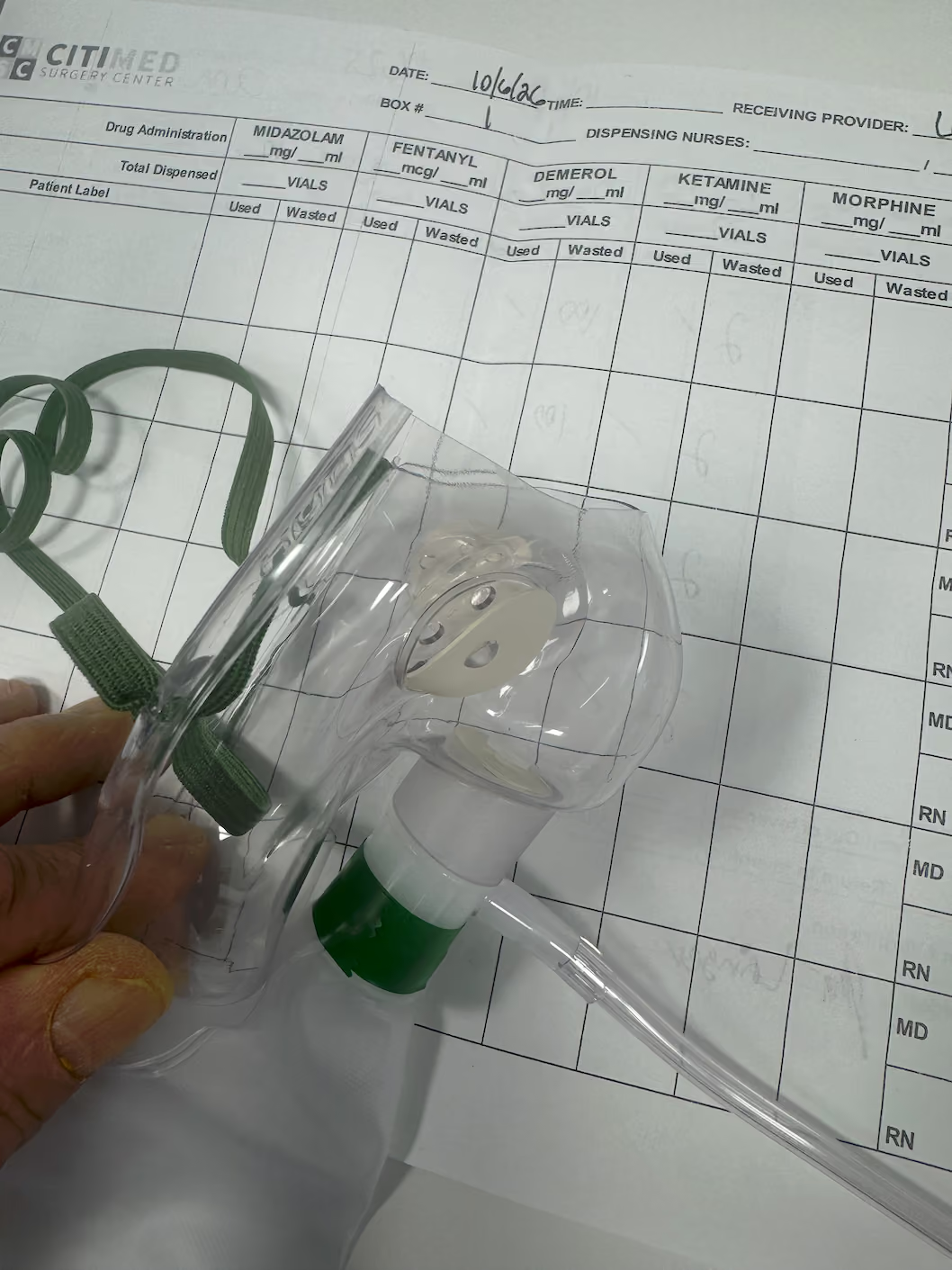
Modified oxygen mask with a cut-away opening and attached tubing.
In Labor & Delivery we had an issue getting parturients to wear an oxygen mask when "required".  Naturally, when breathing heavy during contractions, CO2 accumulates rapidly making the mask feel constricting and the parturients would remove them.  By cutting off the top of the mask at about the level of the bridge of the nose, you still create a high O2 space in front of the mouth & nose, but the open top allows CO2 to escape easily, making heavy breathing more comfortable, improving compliance & SPO2.  This was published in Anesthesia & Analgesia in 1996.

Simple modification of a medium concentration (Hudson type) oxygen mask improves patient comfort and respiratory monitoring with capnography
       Anesth Analg. (1996)  Jul;83(1):202.  Langer RA
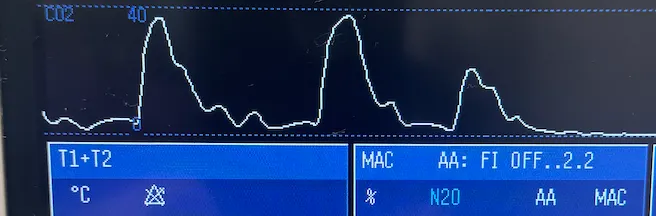
Capnography monitor showing a change in the respiratory waveform.
Propofol takes about 60 seconds from administration until you can reliably expect to get the maximum effect from the dose you just gave.  If you watch the end tidal CO2 wave, when you notice a change from the regular waveform, that is when the propofol is really starting to kick in.  I also tell this to my surgeons, so it gives them something to do while they are waiting to start.
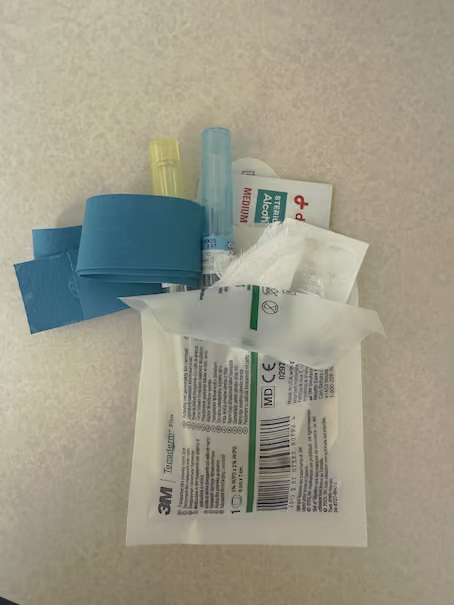
IV placement supplies bundled together as a prepared kit.
Open a fresh Tegaderm about 1"/2.5 cm, add an alcohol wipe or two, some IV Catheters, a few gauze and a tourniquet to the package to make little IV placement kits in advance.

You can also accumulate the trash inside the empty Tegaderm package.  This makes just one neat little package to pick up & toss in the garbage.
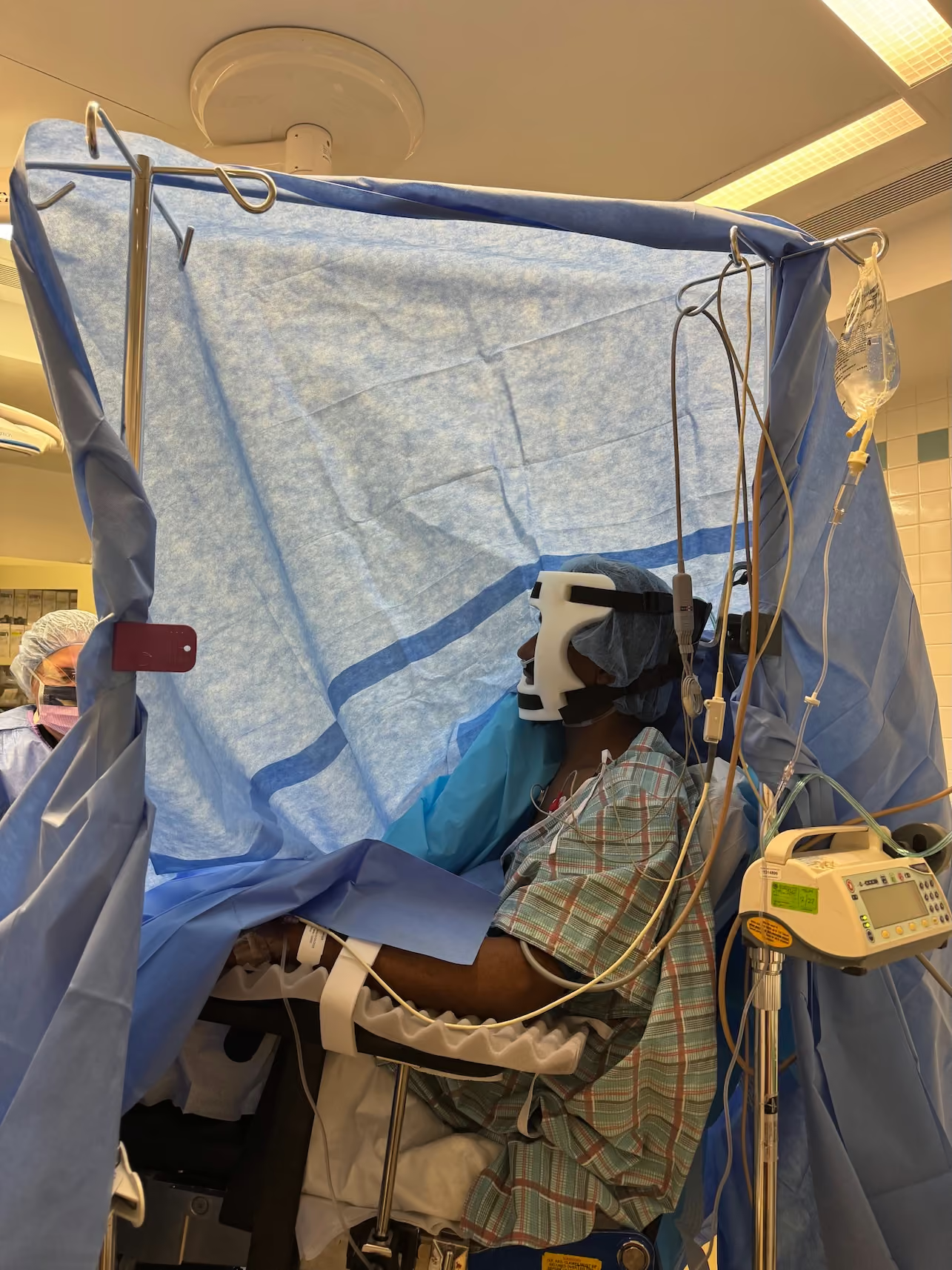
Draping tent and anesthesia equipment arranged for shoulder arthroscopy.
in beach chair position, you get better access to the patient if you make a “tent”:  IV poles should be set to about 6 feet/2 M tall, roll the edges of the final top drape, lay the rolled edge over the top of the IV poles, roll more of the drape edge along the sides until the drape tension is appropriate before clipping them to the poles, then roll the under-drapes completely off the patient’s head and face for good access to the airway and good visual surveillance.

Various text passages:

     For the patients: Present a competent, calm, and empathetic face that helps them relax by making them feel confident in your abilities.  If you can make people laugh—or at least smile—it can go a long way toward reducing their tension and anxiety.  People will not always remember exactly what you said or how well you performed your job, but they will remember how you made them feel. (1)  Try to earn and be deserving of their trust, because this is what will calm them the most, and could reduce the potential for litigation.(2)
       
You are at the center of a lot of interactions: the anesthesiologist must interface with surgeons, pre-op/O.R./PACU/floor nurses, other providers, administration, patients, family members, and many others.  You have an opportunity to be a facilitator.  Diplomacy is essential here as well.  It is important to uphold appropriate standards and not cave in to unreasonable demands that might increase risk to the patient, but there are many different ways of saying the same thing.
‍
[1]  How Do Patients Define Satisfaction? The Role of Patient Perceptions of Their Participation and Health Provider Emotional Expression.
       Health Communication.   (2021) Dec;36(14):1970-1979.  Baker SC, et al.

‍[2]  The Effect of Shared Decision-Making on Patients’ Likelihood of Filing a Complaint or Lawsuit: A Simulation Study            
       Ann Emerg Med. (2019) Jan 3;74(1):126–136.  Schoenfeld EM, et al.
       A recurring theme throughout this book is that more anesthesia is not necessarily better anesthesia. The goal is to provide enough medication to accomplish what is required at each stage of the procedure, without unnecessarily exposing the patient to the adverse effects of additional medication. Sometimes the best anesthetic technique is simply to give less, but to give it at the right time.
       Anticipating issues before they become problems is a large part of the anesthesiologist's job. If you notice and can stop the small pebbles before they lead to the large problem boulder rolling, you can prevent an avalanche. If you recognize the direction a clinical situation is headed and act early, it is usually easier to prevent a problem than to resolve one. I like to think of it as scanning the horizon, so I can navigate a different course that avoids problems while they are still only issues.
       I am an “old-fashioned” physician. I like to take the time to actually engage with my patients and do things “the right way.”  Unfortunately, some places I have worked in the past have been more concerned with maximizing the number of procedures and have sometimes seemed willing to cut corners to do so. As I said earlier, my business as an independent anesthesiologist depended on being invited back, which would not happen if I routinely canceled cases or delayed the schedule "unnecessarily". The constant pressure to move faster, combined with the worry that something important might be missed is stressful and can contribute to physician burnout.(3)  Over the years, I have found ways to “compromise” by moving more efficiently while still maintaining my high standards and never cutting corners on safety.  I have learned the difference between rushing and being efficient.
‍
[3]   Associations of physician burnout with career engagement and quality of patient care: systematic review and meta-analysis
‍
           BMJ.  (2022) Sep 14;378:e070442.   Hodkinson A, et al.
From the STORIES Section: "That's the way things have always been done" - At a large family gathering, the youngest mother is preparing dinner. When she cuts six inches off the end of the roast before putting it in the pan, her husband asks her why.  She scratches her head, thinks for a minute, and replies, “Because that's the way my mother always did it.”They go into the living room and ask her mother why, but they get the same response: “Because that's the way my mother always did it, and I learned from her.”  So, they call Grandma, who is on vacation in Hawaii. When she gets back from surfing, they ask her the same question: “Why did you always cut six inches off the roast?”  Her reply was: “That's 'cuz your grandpa was too damn cheap to buy a bigger pan!”

Lesson:
Always ask the underlying reason for doing something a certain way when it doesn't make sense. Make sure the reasons are still valid for the circumstances you are dealing with today.
Unfortunately, syringe pumps are not cheap and may not be available where you work.  These are some alternatives that can achieve a similar effect when a pump is not available. Giving 1 CC of propofol every 2 minutes (either on all the even or odd numbered minutes) to a 70 kg patient is equivalent to 71.4 mcg/kg-min.(4) You can vary the amount you inject or the time interval to adjust your effective rate using rough mental calculations/estimations, or I made a table in a spreadsheet (included in the book) for greater accuracy in documentation over a wider range of circumstances.
  
Rapid intermittent small boluses
       (4) -- (10 mg / 2 Min * Pt Weight) x (1000 mcg / 1 mg)  ==>  (10/(2*70) x 1000)  =  71.4 mcg/kg-min
      One useful way to assess an individual patient's tolerance to anesthesia is to observe their response to the initial sedative medications.  For example, if an initial dose of midazolam 2 mg and fentanyl 50 mcg produces little apparent sedation, that is a useful clue that the patient may require more propofol than average for induction & maintenance .  Conversely, if the same initial dose leaves the patient completely asleep and unresponsive to verbal stimulation, I would expect them to need less propofol.
       When you repeatedly observe how patients respond to a “standardized” initial dose, you gradually develop a “feel” for their individual medication requirements. It becomes less about memorizing a particular dose and more about recognizing where a patient falls on the spectrum of sensitivity to sedation—and using that information to guide what you do next.
5) intraprocedural Dose Adjustment
       Think of total intravenous anesthesia (TIVA) maintenance as titrating two separate endpoints: The first is the depth, initially determined by the first bolus, then by additional boluses as required.  The second is the infusion required to keep the depth optimal, running throughout the procedure.  Based on the degree of motion (see below), additional smaller boluses can be added to optimize the depth.  If too many additional depth boluses need to be added, then the maintenance infusion needs to be increased.
       Scale of movement to assess anesthetic depth:
              Once the procedure is underway, I continually look for signs of responsiveness along a spectrum: a slight facial scrunch, twitching of the fingers or feet, movement of an entire arm or leg, purposeful movement such as reaching or attempting to sit up, or a coherent verbal response.  The amount of additional propofol I give depends on where the patient is along this spectrum.
       You have to get through the procedure safely, but the job does not end when the procedure is finished. Think ahead.  Consider how the medications you choose are likely to affect emergence, recovery, and the patient's ability to go home.  Whenever possible, anticipate problems before they occur and choose a medication combination or technique that accomplishes what you need during the procedure without creating unnecessary problems afterward.
Bluetooth Radiation Monitor Badge
       I do a lot of cases that involve intra-operative C-arm x-rays.  Because I travel between many different facilities, and each facility has their own x-ray monitoring system, it is not easy to have consistent monitoring of my personal x-ray exposure across all these facilities.  However, I found a company that will “rent” a badge that records exposure and wirelessly transmit the information to an app on my phone that shows a graph over time.  I can carry this badge to all the facilities I work at, so my overall x-ray exposure can be recorded accurately, displayed visually, and can be shared with a facility upon request. (company contact info follows in the book)

Equations (all of which are "live" in the App version):

1) Minutes left in infusion pump
         = (ml in syringe) / (rate in ml/hour) x (60 min/hour)
        If (rate is in mcg/Kg/Min) => Add equation below to convert to ML/Hr
         ((Rate in mcg/Kg-min) x 60 x (Pt Wt in Kg)) / 10,000  =  Rate in Ml/Hr

2) Minutes Left in Oxygen Tank  = [(Pressure in psi − 200 psi safety reserve) × Cylinder Factor] ÷ Flow Rate (L/min)
         (table of cylinder factors follows in the book)

5) BMI = weight (in kg) / Height (M2)

Maximum Local Anesthetic Dose Calculator

Pediatric ETT Size Calculator

Other miscellaneous useful information:

Interpreting Arterial Blood gases

Normal Pediatric Vital Signs

Opioid Equivalents

Hepatic Cytochrome P450 Metabolized Medications & Interactions.

‍

Table of Contents

Foreword5
PREFACE5
DISCLAIMERS5
About the Author6
Attitude is everything8
The importance of getting along8
Bedside Manner:10
Philosophical Perspectives13
Be efficient, but don’t rush15
Stories that Demonstrate Important Principles17
Trust Your Gut Feelings17
Stand Your Ground18
Be adaptable18
“That's the Way Things Have Always Been Done”18
Be Helpful19
Thyroid Collars Make a Difference19
Paying Attention is Key20
Techniques are also important22
Propofol Considerations22
1) Rapid intermittent small boluses22
2) Using an IV side-set22
3) Using a Bard InfusOR Pump23
Planning23
1) Case Type24
2) Duration25
3) Positioning And Airway25
4) Patient Tolerance25
5) Intraprocedural Dose Adjustment26
6) “Propofol Twitches”27
7) Emergence And Post-Op28
Other Propofol Tips28
Propofol and Lidocaine29
Airway Considerations31
Prone Position32
Obstructing? First Extend the Neck32
Next, a Jaw Thrust, but open the mouth33
Oral Nasopharyngeal Airway33
If all these fail, time for an LMA or ETT34
Laryngospasm34
Rolling a patient from Prone to Supine onto a stretcher with 2 people35
IV Tips37
Quick Flush37
Comfort Issue37
Flow Control Valve37
Easy IV kits37
Keep it Clean37
Positional IV37
Difficult Veins38
In the PACU39
O.R. Tricks40
Pre-releasing the Drapes40
Pulse Oximeter security 140
Pulse Oximeter security 240
Anesthesia Circuit Neatness40
Improved Visibility During Shoulder arthroscopy41
IV Safety When Moving from Beach Chair to Stretcher41
Enjoy the View41
ETCO2 Closer to O2 Source41
Nasal Cannula Hair Holder42
Berman OPA and a Nasal Cannula42
O2 Extension42
Arm Restraint Keeper42
O2 Comfort42
Reassuring suggestion42
Useful Acronyms42
Quieter Monitor43
3-way Stopcock on ETCO2 Tubing43
Leave B/P Cuff on the Pt During Transport43
Phenylepherine multi-dose vial43
Alternative Respiration Monitor44
Syringe Prep44
Organizing the Medications44
Organize The Empty Fluid Bags44
Miscellaneous:46
When Pre-oping, Look at Medications First46
Learn New Languages 1 phrase at a time46
The Slow Push46
Always record 1st Vital Signs Before giving any Meds46
Give Sedation before treating B/P47
Glycopyrrolate is gentler for Bradycardia than Atropine47
Be patient, Hydralazine takes time47
Unnecessary Waste Costs Everyone47
Bring Nasal Cannula to PACU48
O2 Concentrator Tips48
Bookmark49
Divide & Conquer49
Neater ECG49
Maximize your O2 Tank Time49
No Suction, No Induction:50
Use 2 Hands to Apply B/P Cuff50
Bluetooth Radiation Monitor Badge50
Easy, Light Portable Radiation Sheild:51
Deep enough?51
Narcotic Notation:52
Horseshoe Pillow Cover Options:52
Microdosing Narcan52
Setting up an Independent Practice53
Equipment and Supplies:53
Controlled Substances54
MEDICATIONS54
IV Supplies55
Airway & Oxygen Equipment55
Multiple Locations55
The Reality of Running Your Own Practice56
TABLES & Spreadsheets57
A) Propofol by intermittent injection57
B) Propofol by Side-set: Calculating the drip rate58
C) Bard InfusOR Pump: More precise delivery options58
EQUATIONS60
1) Minutes left in infusion pump60
2) Minutes Left in Oxygen Tank60
3) Convert between Ml/Hr <=> mcg/Kg/Min60
4) Actual Propofol used60
5) BMI60
6) Creatinine Clearance60
7) Pediatric ETT Size60
8) Maximum Local Anesthetic Doses in adults61
9) Opioid Equivalents61
10) Blood Gas Interpretation62
Other useful miscellaneous information65
Normal vital signs range in children65
Hepatic cytochrome p450 medication interactions65
Pharmacokinetics70
Index1 (Page #s)71
Index2 (internal links)73
References74
Full Table of Contents

The complete table of contents from the current manuscript.

SectionPage
Foreword5
PREFACE5
DISCLAIMERS5
About the Author6
Attitude is everything8
The importance of getting along8
Bedside Manner:10
Philosophical Perspectives13
Be efficient, but don’t rush15
Stories that Demonstrate Important Principles17
Trust Your Gut Feelings17
Stand Your Ground18
Be adaptable18
“That's the Way Things Have Always Been Done”18
Be Helpful19
Thyroid Collars Make a Difference19
Paying Attention is Key20
Techniques are also important22
Propofol Considerations22
1) Rapid intermittent small boluses22
2) Using an IV side-set22
3) Using a Bard InfusOR Pump23
Planning23
1) Case Type24
2) Duration25
3) Positioning And Airway25
4) Patient Tolerance25
5) Intraprocedural Dose Adjustment26
6) “Propofol Twitches”27
7) Emergence And Post-Op28
Other Propofol Tips28
Propofol and Lidocaine29
Airway Considerations31
Prone Position32
Obstructing? First Extend the Neck32
Next, a Jaw Thrust, but open the mouth33
Oral Nasopharyngeal Airway33
If all these fail, time for an LMA or ETT34
Laryngospasm34
Rolling a patient from Prone to Supine onto a stretcher with 2 people35
IV Tips37
Quick Flush37
Comfort Issue37
Flow Control Valve37
Easy IV kits37
Keep it Clean37
Positional IV37
Difficult Veins38
In the PACU39
O.R. Tricks40
Pre-releasing the Drapes40
Pulse Oximeter security 140
Pulse Oximeter security 240
Anesthesia Circuit Neatness40
Improved Visibility During Shoulder arthroscopy41
IV Safety When Moving from Beach Chair to Stretcher41
Enjoy the View41
ETCO2 Closer to O2 Source41
Nasal Cannula Hair Holder42
Berman OPA and a Nasal Cannula42
O2 Extension42
Arm Restraint Keeper42
O2 Comfort42
Reassuring suggestion42
Useful Acronyms42
Quieter Monitor43
3-way Stopcock on ETCO2 Tubing43
Leave B/P Cuff on the Pt During Transport43
Phenylepherine multi-dose vial43
Alternative Respiration Monitor44
Syringe Prep44
Organizing the Medications44
Organize The Empty Fluid Bags44
Miscellaneous:46
When Pre-oping, Look at Medications First46
Learn New Languages 1 phrase at a time46
The Slow Push46
Always record 1st Vital Signs Before giving any Meds46
Give Sedation before treating B/P47
Glycopyrrolate is gentler for Bradycardia than Atropine47
Be patient, Hydralazine takes time47
Unnecessary Waste Costs Everyone47
Bring Nasal Cannula to PACU48
O2 Concentrator Tips48
Bookmark49
Divide & Conquer49
Neater ECG49
Maximize your O2 Tank Time49
No Suction, No Induction:50
Use 2 Hands to Apply B/P Cuff50
Bluetooth Radiation Monitor Badge50
Easy, Light Portable Radiation Sheild:51
Deep enough?51
Narcotic Notation:52
Horseshoe Pillow Cover Options:52
Microdosing Narcan52
Setting up an Independent Practice53
Equipment and Supplies:53
Controlled Substances54
MEDICATIONS54
IV Supplies55
Airway & Oxygen Equipment55
Multiple Locations55
The Reality of Running Your Own Practice56
TABLES & Spreadsheets57
A) Propofol by intermittent injection57
B) Propofol by Side-set: Calculating the drip rate58
C) Bard InfusOR Pump: More precise delivery options58
EQUATIONS60
1) Minutes left in infusion pump60
2) Minutes Left in Oxygen Tank60
3) Convert between Ml/Hr <=> mcg/Kg/Min60
4) Actual Propofol used60
5) BMI60
6) Creatinine Clearance60
7) Pediatric ETT Size60
8) Maximum Local Anesthetic Doses in adults61
9) Opioid Equivalents61
10) Blood Gas Interpretation62
Other useful miscellaneous information65
Normal vital signs range in children65
Hepatic cytochrome p450 medication interactions65
Pharmacokinetics70
Index1 (Page #s)71
Index2 (internal links)73
References74